
Nozawaonsen Matsuri
Dōsojin Matsuri (Festival)
Held every year from January 13 to 15, the Dōsojin Matsuri is one of Nozawa Onsen’s most important traditional observances, bringing together sacred rites, communal work and ceremonies centred on the village’s Dōsojin deities. Although best known for the Fire Ceremony on the night of January 15, the Matsuri unfolds over three days and is the culmination of months of preparation by local residents.
Visiting during the Dōsojin Matsuri
The ceremonies and preparations taking place throughout the village on January 13 and 14, and during the daytime on January 15, are open for everyone to observe.
Access restrictions apply only to the Fire Ceremony on the evening of January 15, which takes place within a controlled area. Please check the Fire Ceremony access information below before attending.
Fire Ceremony Access
For safety reasons, access to the Fire Ceremony on the night of January 15 is restricted to Nozawaonsen Village residents and guests staying overnight at accommodation within Nozawaonsen Village. An admission ticket is required to enter the venue. The festival site is located on a gentle, snow-covered slope and becomes extremely crowded, so the number of people admitted is limited for safety reasons.
The Traditions of the Dōsojin Matsuri
Dōsojin are kami (deities) of Japanese folk belief, traditionally enshrined at village boundaries and crossroads to protect communities from calamity and harmful influences. Also known by names such as Dōrokujin, Sainokami and Saenokami, they are worshipped in many forms throughout Japan and are also associated with fertility, the healthy growth of children and good relationships.
In Nozawa Onsen, Dōsojin are traditionally represented as a male-and-female pair. They are especially prayed to for good matches and marriage, fertility, and the healthy growth of children.
With a history spanning more than 300 years, the Dōsojin Matsuri (Festival) takes place every year from January 13 to 15. It is designated by the Japanese government as an Important Intangible Folk Cultural Property and is often described as one of Japan’s three major fire festivals.
At the heart of the Dōsojin Matsuri are the men of the village in their yakudoshi — ages traditionally considered particularly vulnerable to misfortune, often referred to as the “unlucky years”. In particular, the groups reaching the ages of 25 and 42 take on central responsibilities in carrying out the festival. They work under the overall supervision of the Nozawagumi Soudai, the traditional residents’ organisation that protects and manages communal assets including the village’s forests, water sources and hot springs.
Preparations begin long before January. In mid-September of the previous year, materials for the festival shrine structure are gathered from the village’s communal forest. Five straight beech trees, approximately 18 metres long and 30 centimetres in diameter, are selected as the Sacred Trees (goshinboku) to be used in the construction of the shaden.
The Sacred Tree Felling Ceremony takes place in mid-October. Before any tree is cut, prayers are offered to the mountain deity for the safety of everyone involved, and a temporary altar is erected in the beech forest. The trees are then felled by the yakudoshi men under the direction of the yama-tōryō, the mountain master carpenter.
Two of the Sacred Trees are stored at the Hikage ski area until January 13, when the Goshinboku Satobiki begins. The day starts with a race on the Hikage slope between the 25- and 42-year-old yakudoshi groups, each hauling one of the enormous Sacred Trees. Once the race is over, the competitive element ends and the trees are hauled entirely by hand down the slope and through the village over several hours, accompanied by calls of encouragement and offerings of sake along the route.
On the morning of January 14, construction of the great festival shrine structure, or shaden, begins under the direction of the shaden-tōryō (shrine-building master carpenter). Work continues late into the night and resumes on the 15th, with the structure completed around midday.
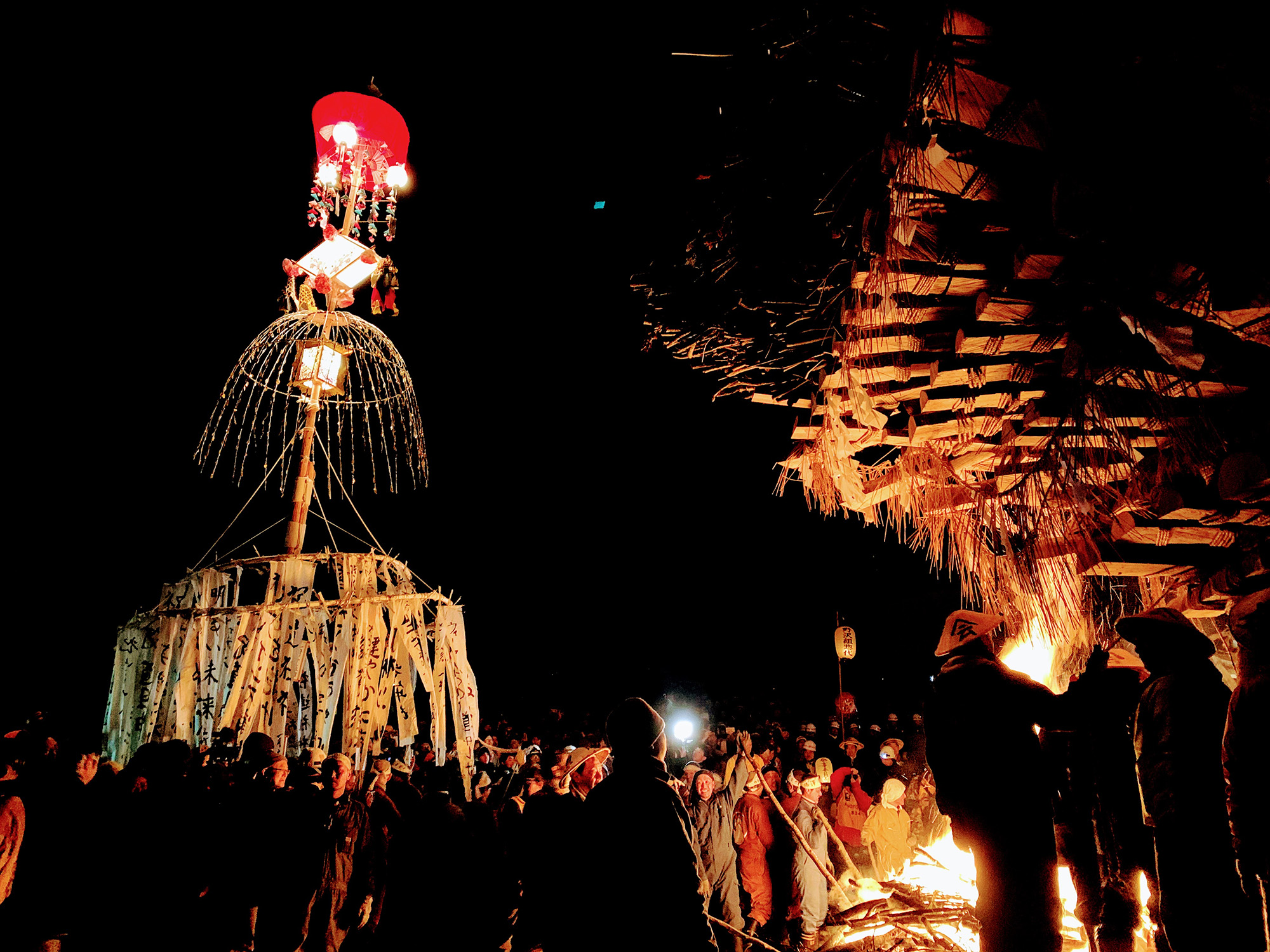
The shaden itself stands approximately seven metres high, while the Sacred Trees forming its central pillars extend more than ten metres above it. It is constructed using traditional methods, without nails or wire. Because the work is dangerous, alcohol is prohibited once construction begins, and the men work under the close direction of the master carpenter until the structure is complete.
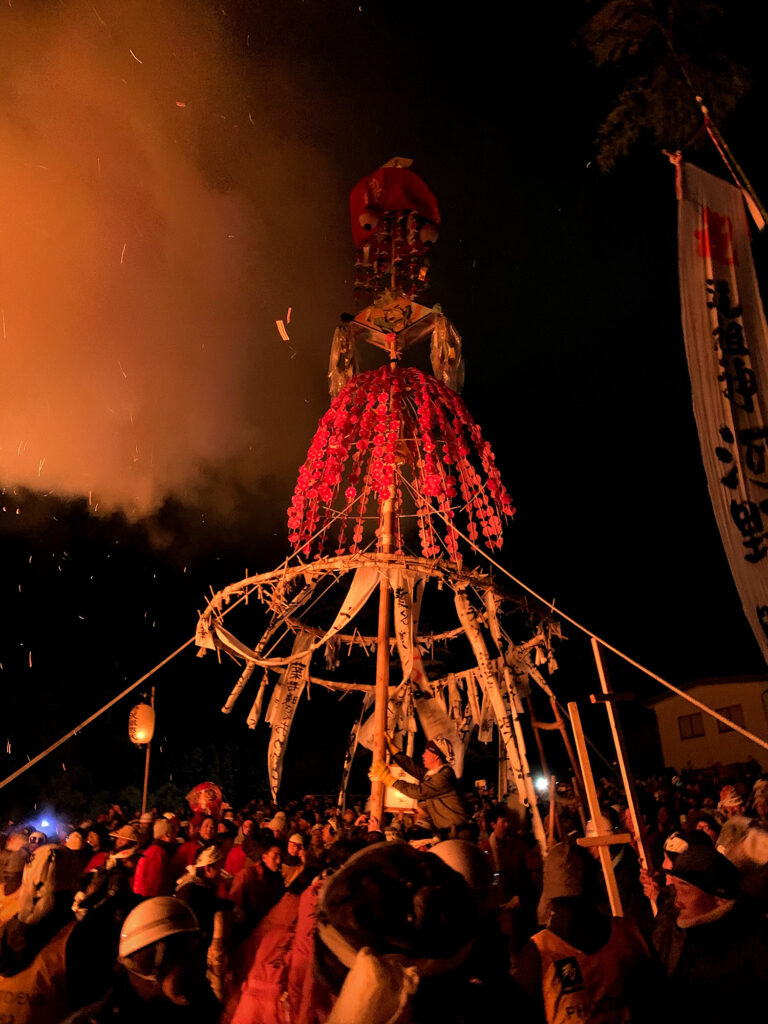
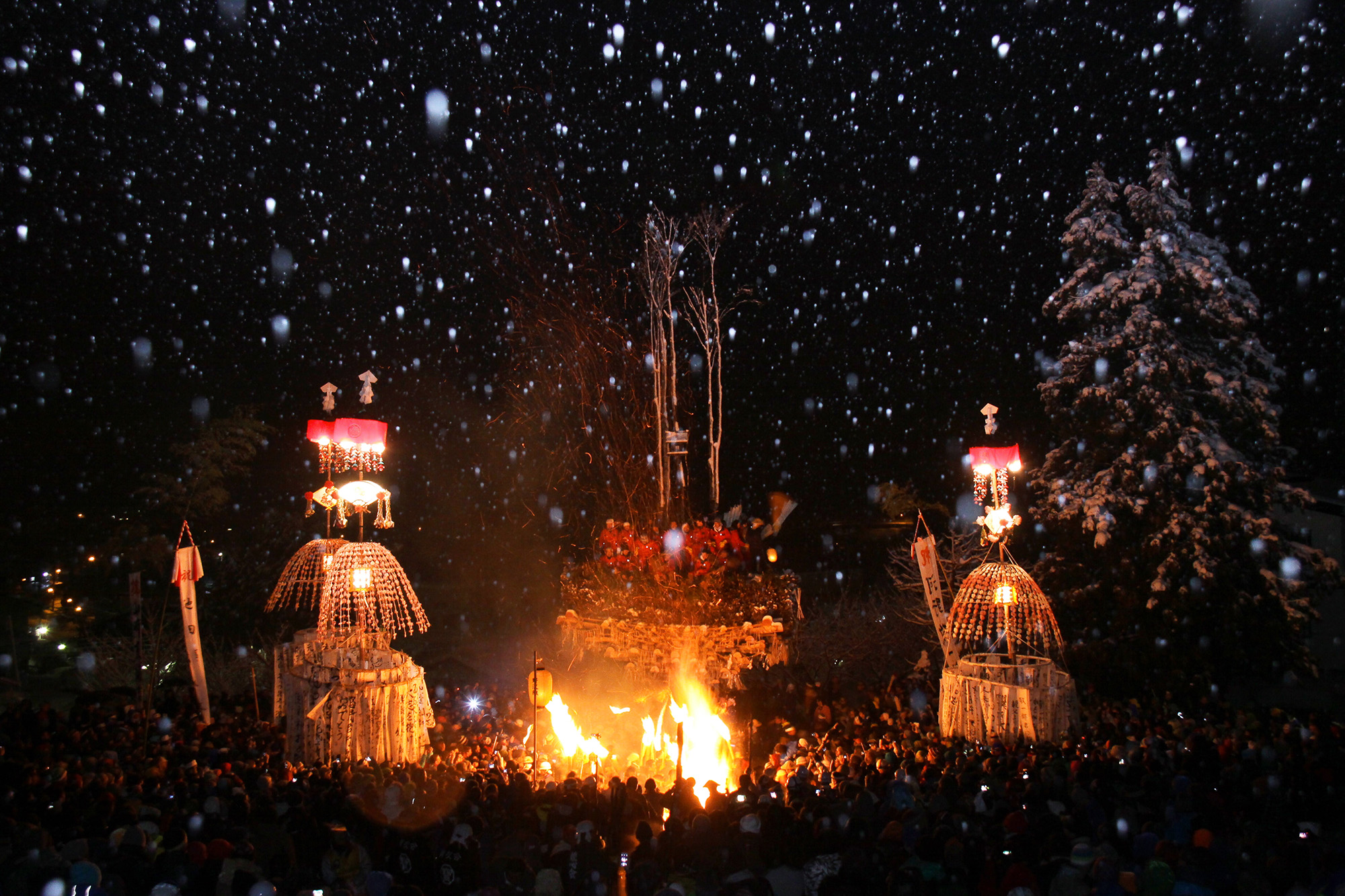
Meanwhile, families who have welcomed a baby during the previous year prepare a towering hatsu-tōrō lantern, dedicated to the Dōsojin in prayer for the child’s healthy growth. Standing more than nine metres high, each lantern is decorated with handwritten messages of good wishes for the baby from family and friends.
On the evening of January 15, those connected with each hatsu-tōrō carry it in procession through the village towards the Dōsojin festival site. Accompanied by torches, they proceed through the streets singing traditional Dōsojin songs before the lantern is erected beside the shaden.
Shortly afterwards, the himoto, the ceremonial source fire, is brought to the festival site. The flame is transferred to a pile of boya — small branches and brushwood — positioned about 30 metres from the shaden, creating the fire source used during the Fire Ceremony.
What follows is a highly structured ritual battle between those attempting to set fire to the shaden and the yakudoshi men charged with defending it. The 42-year-old men take their positions on the upper part of the structure, while the 25-year-olds defend it from below.
The first attempt to set fire to the shaden is made by the Nozawagumi Soudai, followed by participants associated with the hatsu-tōrō and then the children of the village. Only afterwards do the adult villagers join the ritual battle, and the confrontation gradually becomes more intense.
For around an hour and a half, villagers press towards the shaden with burning torches while the yakudoshi men beat out the flames and defend the structure. By the end, both sides are blackened with soot.
Eventually, the battle is brought to a formal close with tejime, a ceremonial round of rhythmic hand-clapping. The men descend from the shaden, and only then is the fire deliberately placed into the centre of the structure.
Once the flames have grown strong, the hatsu-tōrō are brought into the pillar of fire one by one, bringing the Fire Ceremony towards its conclusion.
The spectacular flames of January 15 are therefore only one part of the Dōsojin Matsuri. The festival is the culmination of months of preparation, sacred rites, communal work and traditions passed from one generation of Nozawa Onsen villagers to the next.
Yuzawa Shrine’s Lantern Festival
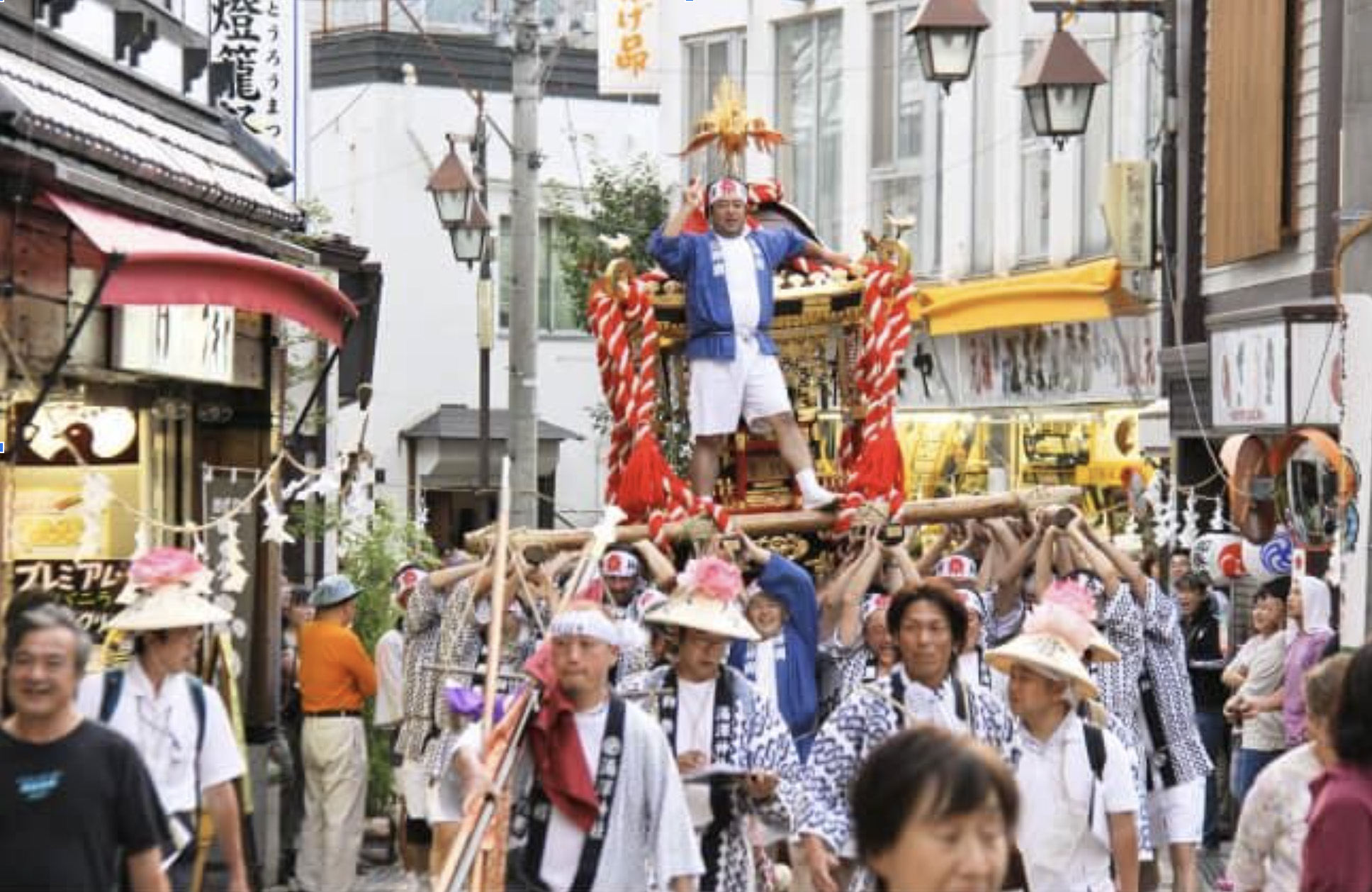
The sky is lit up with glowing orange bulbs when Yuzawa Jinja, the shrine located next to Kenmeiji temple, holds its annual lantern festival on September 8th and 9th. For locals, who believe the event’s origins date to the mid- or late-Edo period (1603–1868), this is one of the most eagerly awaited religious occasions of the year.
It can, however, be a little baffling for the uninitiated. The huge two-day event is conducted by 42-year-old men, whose age (along with 25) is considered unlucky. While a committee—which consists only of men residing in Nozawa Onsen aged between 40 and 42—collectively called sanyako—takes charge of all the preparations, the spiritual dances, such as the Sarutahiko (Shinto god) Dance, the Lion Dance and the Dance of the sanjuroku-kasen (36 great poets), are conducted by an association of Yuzawa Shrine, which handles the preservation of bugaku- imperial court music and dance.
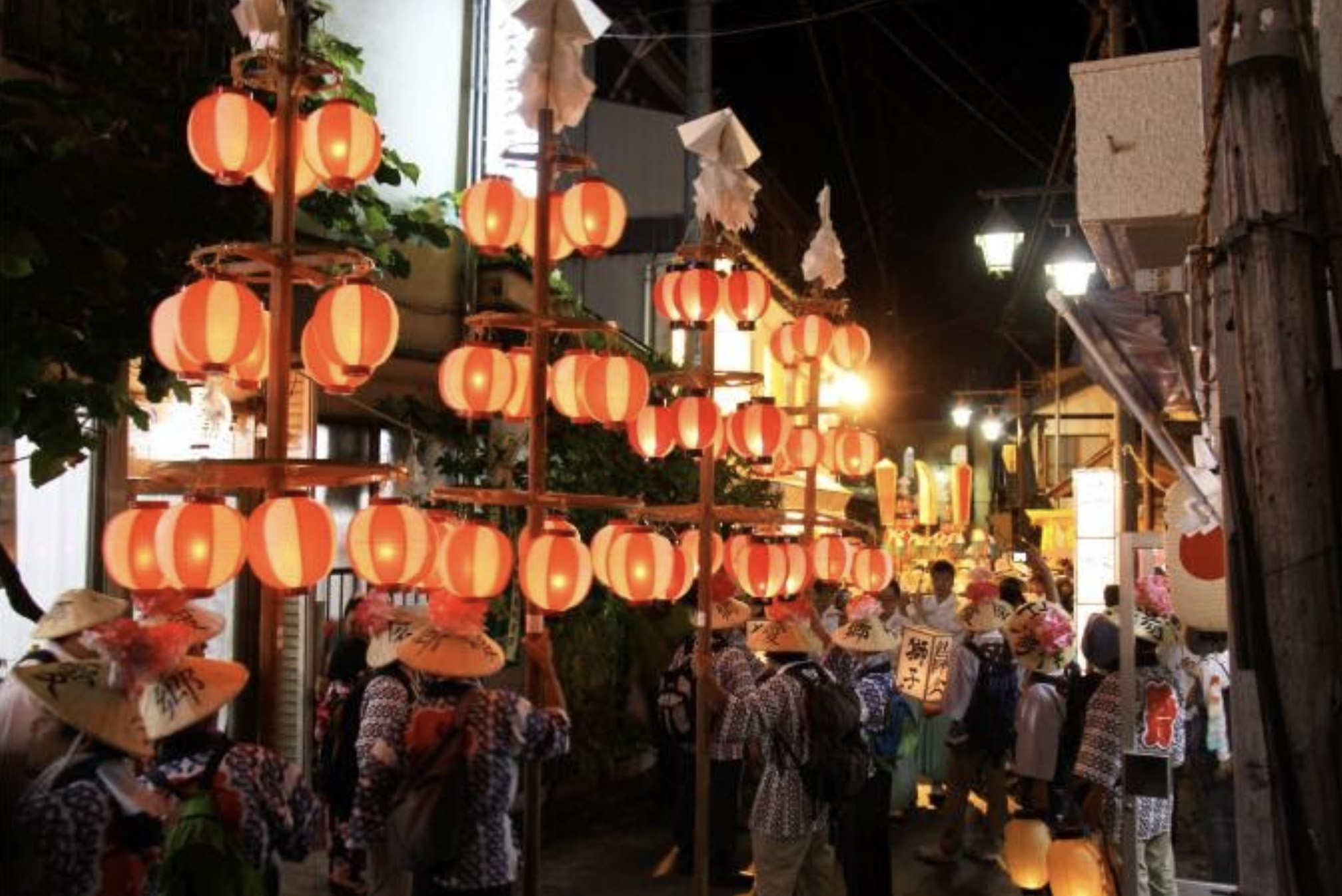
The colourful festivities start on the first day at around 7.30 pm with a fireworks display, followed by the lantern procession, which features the lamps attached on large poles and carried through the streets from the public bath house Juodo no Yu to Yuzawa Shrine via Oyu-dori Street. Don’t miss the performance of Sarutahiko no Mikoto, a Shinto deity who carries out a purifying ritual known as shimekiri. The deity rhythmically swings a large lit torch before cutting a ceremonial rope with a katana sword. Since this unique spectacle usually lasts until midnight, stay sated with some tasty local snacks, which are sold at stalls along the street.